
Precision Teaching & Standard Celeration Charts
Knowledge-Building for Teachers Series

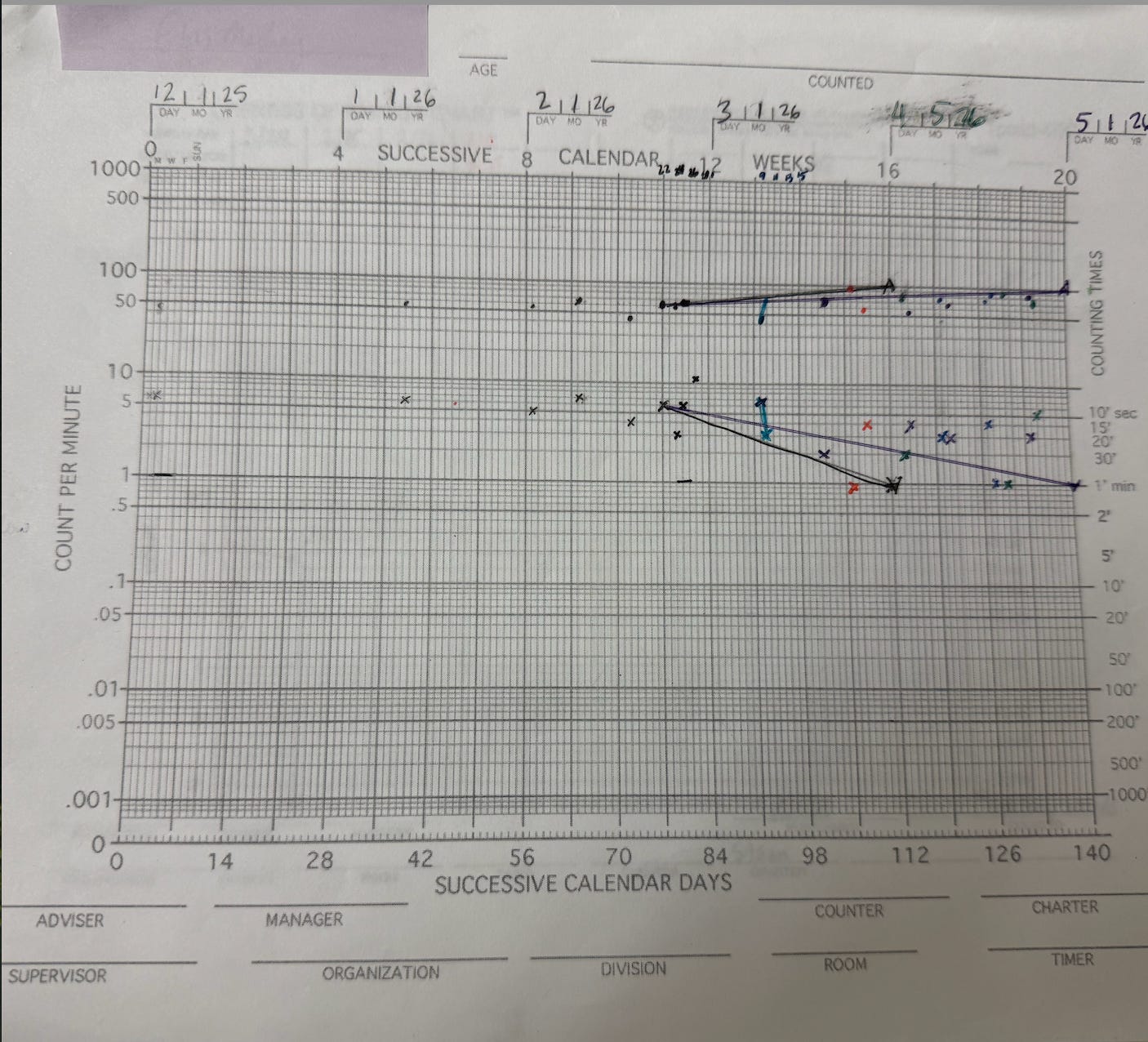
I hesitate to share this post because I am still very, very novice in my knowledge of Precision Teaching and how to use Standard Celeration Charts. However, I have had so much success in such a short amount of time with my novice attempt, that I thought we could all be novices together. For the experts out there, I defer to your expertise if I incorrectly represent something.
I started using a Standard Celeration Chart with two of my students a couple of months ago. Both were struggling with reading fluency, and I wanted to start setting a daily goal of improvement and give them a visual to see their growth. I wrote about the experience and success of one of those students here. The other student was also struggling with accuracy, averaging 85% and not growing. About a month after using the Standard Celeration Chart, he started scoring in the high 90% range on his Acadience progress monitoring. He was also reading 70-80 words per minute, up from 40-60 words per minute. This student has more growth to make, but it was surprising how quickly growth started happening in such a short amount of time.
There is so much more I need to learn about PT and SCCs, including how to break down goals into composite, component, and tool skills and the interventions that support each. I would also like to explore using PT and SCCs in a whole group setting with ORF and math facts. In the meantime, here are resources to begin your own knowledge-building about Precision Teaching and Standard Celeration Charts.
How To Guide
Charting Introduction - The Standard Celeration Society (SCS)
This site has a collection of introductory videos explaining Standard Celeration Charts and how to record data on them.
Podcasts
Brendan Lee and Elana Gordon recently posted interviews about Precision Teaching that are excellent. It’s exciting to see the growing interest in this field.
Something I found very interesting in this interview was how Morningside Academy uses a combination of Direct Instruction, Precision Teaching, Behaviorism, Constructivism, and more to create a cohesive whole of the best of all learning sciences. What is used when is dependent on where the student is in the instructional hierarchy. It was especially interesting how and when they use inquiry or discovery learning. Brendan Lee also wrote a great article about discovery learning here.
S4E21: Precision Teaching with Daniel Carroll with Elana Gordon on The Road to Reading Podcast
Article
The Precision Teaching System: A Synthesized Definition, Concept Analysis, and Process by Amy L. Evans, Andrew J. Bulla, and Andrew R. Kieta
This is a succinct summary of Precision Teaching that “includes (a) an updated definition of PT, (b) a concept analysis of PT, and (c) a set of synthesized steps that comprise PT.”
Video/Webinar
Precision Teaching Webinar Recording – Education Rickshaw with Daniel Carroll and Zach Groshell
This was my introduction to PT. Right after I watched it, I implemented daily goal setting into my math facts routine, encouraging my students to make a goal to solve 1-2 problems more than last time. Stagnant scores began to grow and students were so excited to beat their daily score.
The Morningside Model of Generative Instruction created by Ryan O’Donnell, MS, BCBA, Behavioral Scientist and Filmmaker
If you want to see Precision Teaching in action, this documentary gives an inside look on the incredible success of Morningside Academy.
Books
Response to Intervention and Precision Teaching: Creating Synergy in the Classroom by Kent Johnson and Elizabeth M. Street.
This book is an excellent introduction to Precision Teaching and Standard Celeration Charts. It explains the principles of PT, instructional design for PT, and how to put PT into practice in reading, math, and writing.
Using this for fact fluency is of huge interest to me! Thanks for posting
I've been curious about these for a while and as a math teacher they're definitely appealing. I wonder if you can help me with a question: what is the benefit of a standard celeration chart as compared with a regular tracking sheet where I (or the student) note the student's current personal best and use it to highlight progress?